top of page
Gabriel Linardi
Nautilus Bath House
Providence, Rhode Island
2024
The Parti
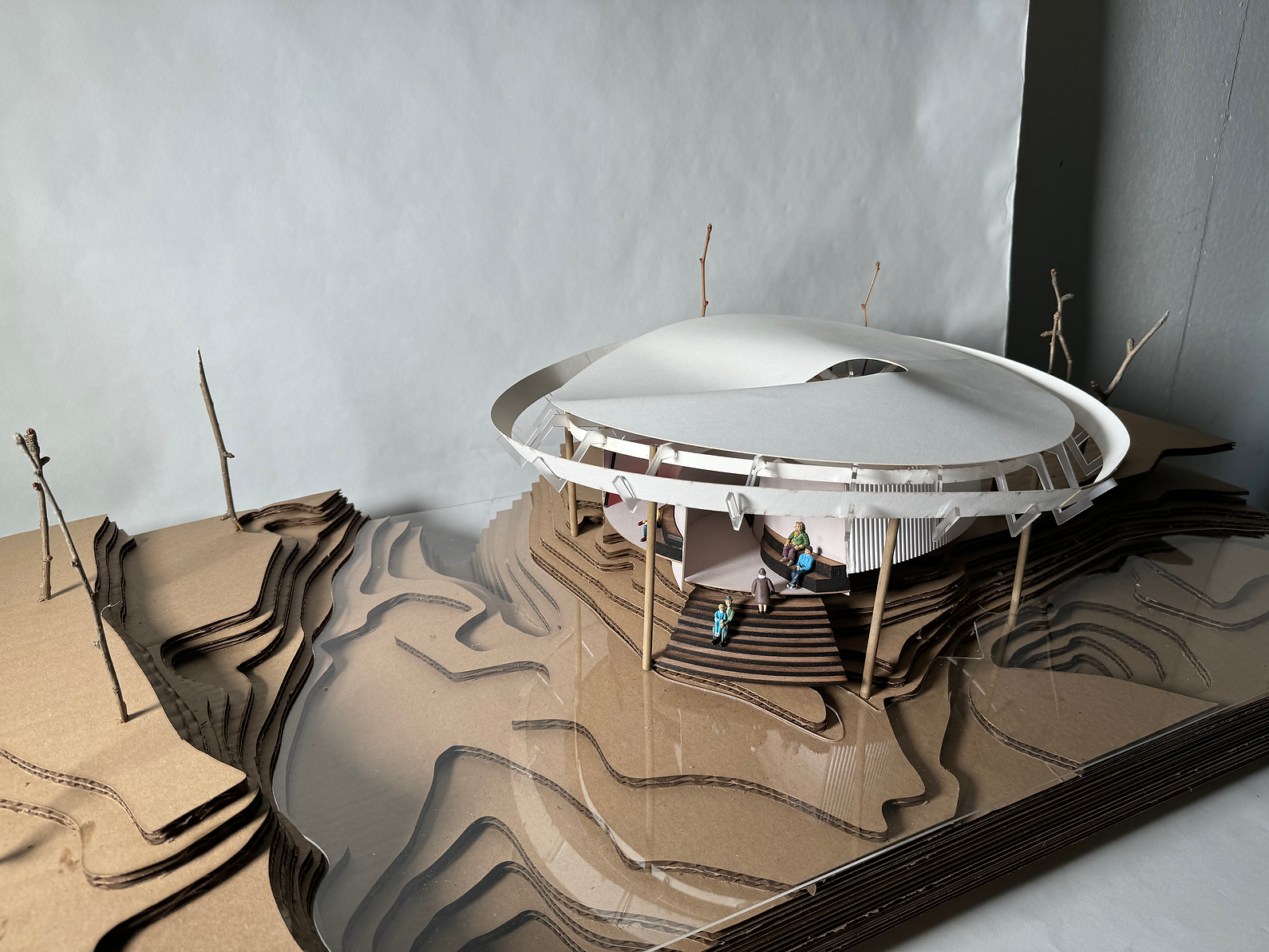
Compression and expansion of cloister and loggia is the parti. Not all walls are built vert-equal (vertical). Canted walls curl inwards and outwards respectively at thresholds--constructing passages of contraction and dilation.
A nautilus-like plan was never the intention, it was the logical and derivative byproduct of a circular cloister. Housed within a perfect circle, the circular cloister accommodates sheltered space for circulation (hallway) and preparation (changing rooms and bathrooms). The cloister surrounds a central open courtyard that combines Roman baths' warmup courtyard with a social/rest area.
Like how a cloister and its courtyard connects a monastery complex, the core open courtyard connects all the bath house's program--serving as a nucleus and space to reconvene under the open sky.
Like a loggia the outermost layer of the circle is outdoors. Open to nature while still sheltered, the loggia is defined by the roof that extends over the walls of the bath house but bound within the exterior belt of columns and reflector band. This carves out an implied space in void for dwelling and rest surrounded by the natural environment.
The Architecture
Similar to ancient Roman baths, the staggered elevation arrangement of each sauna module (hot, warm, and cold)--warmest at the top and coolest at the bottom--allow for passive heating where only one point is heated. Only the highest elevation receives heat, and as heated water gradually travels down to lower chambers with gravity, this water naturally loses heat--therefore supplying the consequent chambers of warm and cool with the correct temperature without consuming extra heating elements and resources. Furthermore, hot air rises and cool air sinks--highlighting again why warmer chambers are elevated while cooler chambers are lowered in order to embrace the natural circulation of air.
A reflecting band of aluminum mounted onto the roof's circumference catches sunlight and mirrors it back into the reflective interior roof and walls also made of aluminum--distributing sunlight throughout the bath house interior.
Red glass beguiles the vista when entering the hot and warm saunas by forcing a polarizing view through red before laying one's eyes on the surrounding outdoor greenery.
Seating and stairs are made of wood because they are points of physical contact in the heated sauna environment and therefore must not conduct heat well. While aluminum was chosen for its reflective and lightweight qualities, concrete was used at for the sauna chambers as aluminum is a good conductor of heat. Concrete when light colored, treated, and polished can be quite reflective and therefore was a great choice in addition to its sustainable thermal mass, sequestration of carbon, and recyclability.
The Circulation
The entrance hallway--where changing rooms and showers are accessed--compresses as the wall curls inwards and gradually tilts back outwards to expand space as visitors' vista transition from changing/bathing to enter the open courtyard. After warming up, socializing, or simply taking time to rest, visitors step into either the hot, warm, or cold chambers and pass through contracting thresholds where the walls again curl inwards--followed by a brief moment where the vista must confront red glass in contrast to the green of the outdoors. The sauna space then swells and opens up to views of the stream and greenery. The cold plunge being the exception, has no red glass to delude the vista. Instead, being at the lowest elevation, the cold chamber opens up directly down a flight of stairs to immerse oneself in the stream.


Drawings


Process
Overhauled first design which was a clash of nonspecific ideas, in addition to not being grounded to scale and the site. This process work nevertheless served to simplify and streamline my following designs.


Beginning the following design with arranging program as module blocks. The arrangement of hot, warm, and cold baths are inspired by the design of Roman Baths which heated only the hottest chamber--relying on gravity to deliver heated water that gradually and passively cools to increasingly cooler chambers. Therefore only one point of heating is necessary for the entire system of baths.


Testing out various circulation ideas of program modules over site.


Testing out module arrangement in section view.


Sketches of structure where the compression-expansion parti was developed. The idea of a double layered circular structure that accommodates for an outer and inner layer of program remained from these initial ideations.


Paper study model that developed into the roof. It is as if a plane was pushed and pulled at control points to enforce program beneath, resulting in various subtle elevations and undulating isocurves.


Selected sketchbook pages where ideas that would become part of the project were recorded and explored.


Laser cutting joints in columns using a cardboard jig to hold each column in place through multiple passes. The columns connect to beams that support rafters in the axis opposite to the beams. The rafters are what come into direct contact with the roof.

All components for the model laser cut. Rafters are frosted acrylic to represent steel | beams are white paper to represent steel | columns, seating, and stairs are timber | roof and reflector are white paper to represent aluminum | floor and walls in white paper represent aluminum | floor and walls in grey paper represent concrete | red acrylic represents red glass panes.


bottom of page